Card identification guide
How to tell if your Riftbound T1 card is serialized
Check the set code at the bottom left first. A serialized card has an asterisk after its card number; the standard card does not.
Standard and serialized cards side by side
These two Galio cards show the same champion card in both versions. The labels below identify each version before you inspect the finer details.
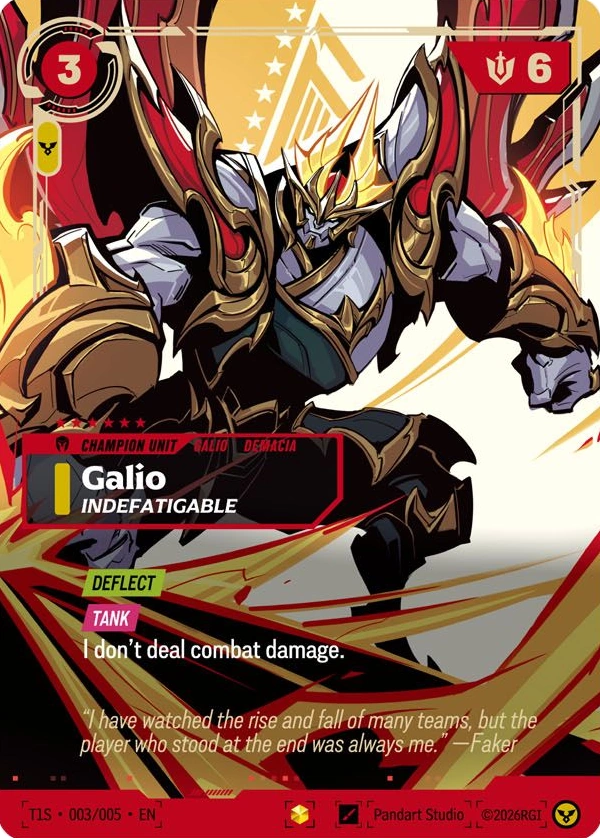
No asterisk and no NNNN/2025 serial box.
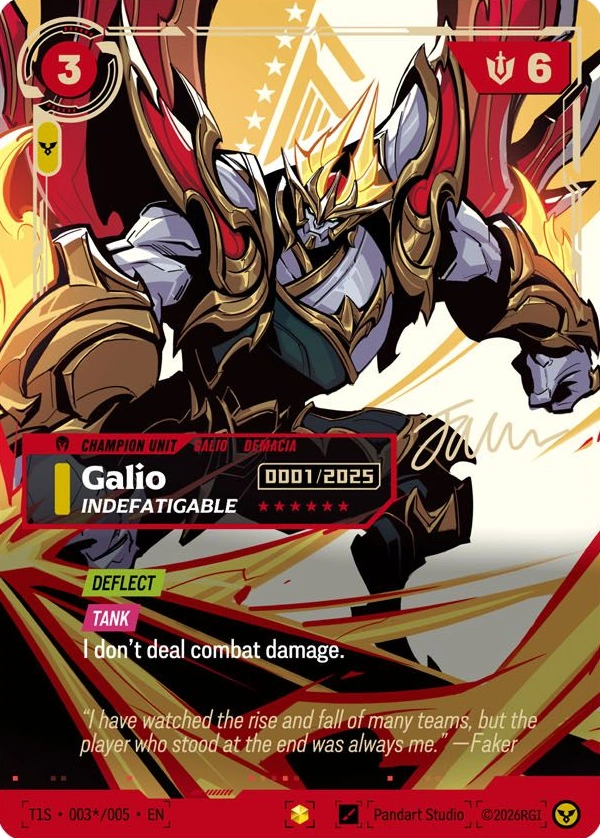
The asterisk confirms that this is the serialized version.
The four tells, in order of reliability
The asterisk in the set code
Look at the set code at the bottom left. The serialized Galio reads
T1S · 003*/005 · EN. The standard version readsT1S · 003/005 · EN. This printed asterisk is the clearest and most objective tell.The NNNN/2025 box
A serialized copy has a numbered box inside the champion name plate. It shows that card's unique serial as
NNNN/2025, such as0042/2025.Six gold stars
Six gold stars appear directly below the serial-number box. They represent T1's six Worlds titles.
A gold signature over the artwork
The player's signature is stamped in gold over the upper-right area of the illustration. Use it as a supporting tell, then confirm the card with the set-code asterisk.
What it is not
A foil card is not automatically serialized. Foil treatment alone does not identify one of the numbered /2025 copies.
Player Bundle cards use the T1A set code, feature different artwork, and are never serialized. They are separate from the T1S Signature Edition cards tracked by this registry.